How can a slope on a property be reinforced?
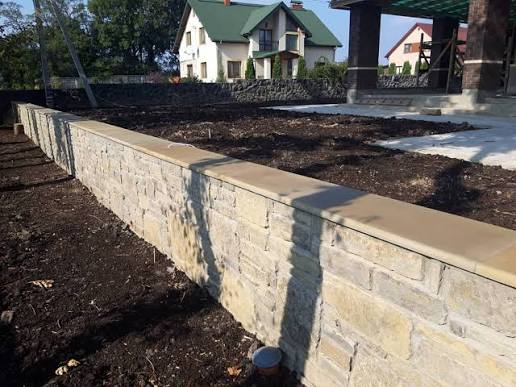
Concrete retaining walls and gabions are among the most common elements used for stabilization work.
A reinforced concrete wall is a monolithic structure suitable for managing elevation changes across various types of sites. This solution is easily applied in private, commercial, and industrial construction. These retaining walls are constructed from high-strength reinforced concrete, ensuring a high load-bearing capacity. Characterized by precise geometry, concrete retaining walls allow for quick and convenient installation. They offer a long service life and require minimal maintenance. Such walls are used to stabilize slopes and embankments, create terraces, facilitate landscaping, support the construction of roads, industrial sites, and parking areas, and establish different elevation levels on sites with complex terrain.
Gabions are mesh structures filled with loose material. They are fabricated from tightly interwoven metal wires that form a grid of standard-sized cells. Natural or artificial stone is typically used as the filler. Gabion structures are frequently installed on sloped terrain. They also help protect sites against soil erosion and landslides during heavy rainfall or other adverse weather conditions. This type of structure is widely used in both landscape design on uneven terrain and civil engineering. Decorative gabions—filled with materials such as granite, basalt, or quartz—deserve special mention. Furthermore, given the current situation involving constant shelling, sand-filled protective gabions have become highly sought after; they are used to safeguard critical infrastructure, cultural landmarks, and other such sites.
Concrete Retaining Wall or Gabions: Which Should You Choose?
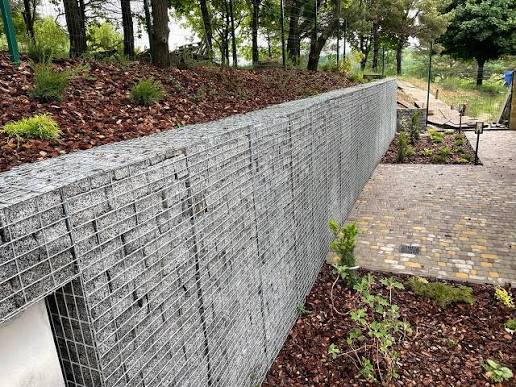
When choosing between these two types of structures, one should consider factors such as elevation differences, soil type, budget, and aesthetic preferences. There is no universal solution; however, a gabion is generally considered the more practical and cost-effective option. A concrete retaining wall, on the other hand, is well-suited for situations involving heavy loads or limited space.
The specific characteristics of these retaining structures are outlined in the comparison table below:
| Criterion |
Concrete retaining wall |
Gabion |
| Water drainage |
It is necessary to install a high-quality drainage system behind the wall. |
No installation required – water flows freely through the gabion. |
| Foundation |
It is absolutely necessary; it must be deep and reinforced. |
Not necessarily. A pillow of crushed stone is quite enough |
| Ability to resist soil movement |
Low stability rating – may break down |
High degree of stability through flexibility |
| Installation Specifics |
The setup requires the construction of formwork and the use of specialized machinery. |
A gabion can be assembled by yourself, following the principle of a construction set. |
| Area occupied on the site |
Minimal, since the design is thin |
Large – requires a wide supporting structure for installation |
Reviewing the specific advantages of a given structure can also help in making a decision. A concrete retaining wall offers maximum strength and is suitable for areas subject to heavy loads, allowing for heights exceeding 2 meters. It occupies minimal usable space and offers great versatility in terms of exterior finishing. Its drawbacks include complex and costly installation, susceptibility to settlement, and strict requirements for a drainage system.
A gabion retaining wall provides natural drainage by allowing water to pass through freely. The flexibility of the structure allows the blocks to adapt to changes in the terrain's shape as the ground settles. Gabion walls are relatively simple to install and can even be constructed during the winter. They blend well into the landscape, as the spaces between the stones become filled with soil and plant roots.