Why concrete floors crack
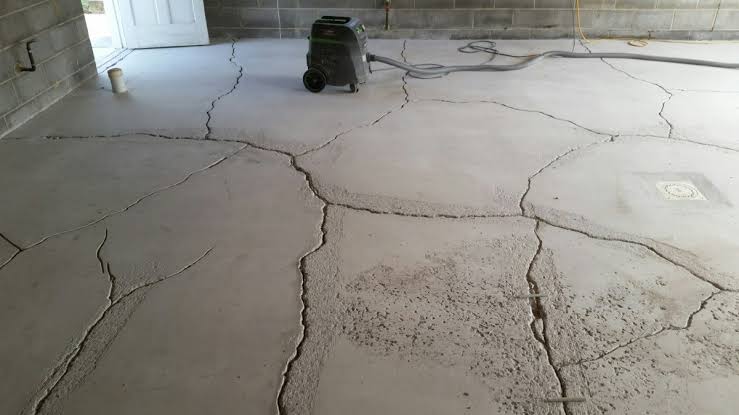
There are several potential causes for the deterioration of concrete. The most common is the appearance of shrinkage cracks. As concrete hardens, excess moisture evaporates. If this process occurs too rapidly, the top layer of the concrete contracts faster than the lower layer. This generates internal pressure that the material cannot withstand. Consequently, concrete shrinkage leads to the formation of surface cracks—resembling a spiderweb—or even deep fractures.
Another cause of cracking in concrete floors is temperature fluctuation. According to the laws of physics, concrete expands when heated and contracts when cooled. If a slab is large, it is unable to move freely; this results in floor deformation caused by the pressure of its own mass.
Cracking can also be caused by errors during the preparation of the base. Most frequently, these errors lead to uneven settling of the soil beneath the concrete slab, which can cause the slab to break apart.
Other significant causes include:
- insufficient screed thickness, surface irregularities, or inadequate reinforcement;
- deviations from standard concreting procedures, such as incorrect proportions of ingredients when preparing the concrete mix;
- the absence of expansion joints in large areas;
- improper structural bonding between old and new layers;
- unplanned interruptions during the concrete pouring process.
Ensuring that concrete retains its intended shape is only possible through proper design and correct execution of the floor-pouring process. That is precisely why, during the work, it is important to strictly adhere to the correct concrete mix design, control the water-cement ratio, and use special admixtures.
Why does a concrete floor produce dust?
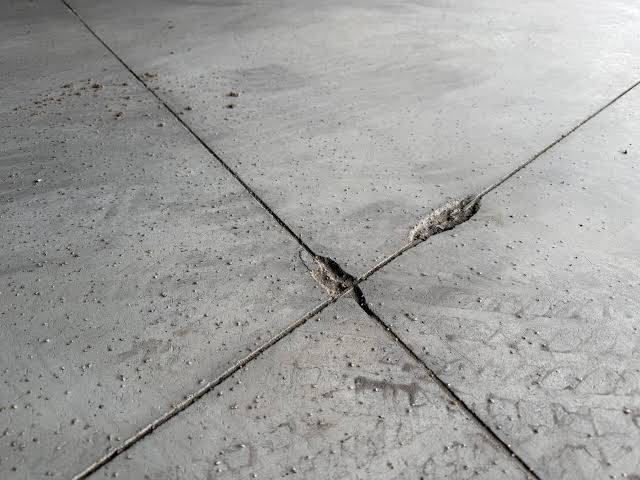
Concrete dusting during use is another issue that can arise following improper concrete installation. This results in floor wear and surface abrasion. Beyond a failure to follow proper technical procedures, concrete floors may produce dust due to the following factors:
- improper mixing of the concrete mix;
- incorrect drying or a failure to maintain proper curing conditions;
- excessive loading—such as heavy foot traffic, vehicle movement, or the operation of heavy machinery on an industrial floor;
- exposure to oils, gasoline, or other chemicals, which can cause the surface layer to delaminate and generate concrete dust.
Addressing existing mechanical damage: how to repair an industrial concrete floor
The most critical factor in planning such repairs is selecting the optimal concrete repair compound. In these situations, it is best to use specialized thixotropic mixtures containing reinforcing microfibers and polymers. The repair process begins by deepening and widening the existing potholes or damaged areas along their perimeter. An angle grinder equipped with a diamond blade is recommended for this task. Keep the following guidelines in mind:
- Cuts should be made 10 mm deeper than the crack itself. The damaged area should be widened by 20–30 mm on the sides. These dimensions can be increased further if necessary.
- The material within the damaged area is removed using a chisel and a rotary hammer. This should result in a rectangular cavity, which must then be thoroughly cleaned of dust and primed. Fill the prepared cavity with the repair compound and level it out thoroughly, piercing the mixture several times to remove air bubbles. Finally, smooth the surface using a straight edge (screed rule).
- For deep cracks exceeding 60 mm, apply the repair compound in several stages, ensuring that the thickness of each individual layer does not exceed 20 mm. Once the compound has set, sand the surface smooth, checking for evenness with a spirit level.
Work should be performed while wearing protective gear, including gloves, safety goggles, and a respirator. It is advisable to open windows, and the floor surface may be finished with a specialized concrete paint.